1st Bi weekly knowledge sharing Virtual Seminar Session: Career Pathway and Scopes for Service Providers in Urban Health Services of Different Ministries or Government Bodies
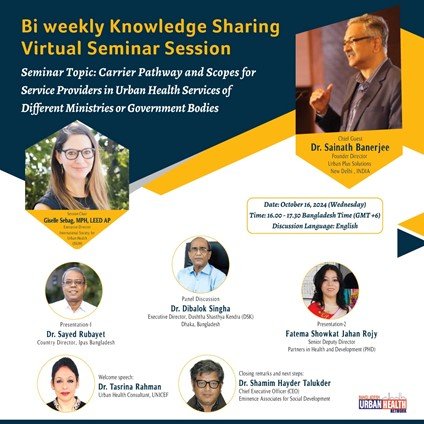
The bi-weekly Knowledge Sharing Virtual Seminar Session titled "Career Pathway and Scopes for Service Providers in Urban Health Services of Different Ministries or Government Bodies" was successfully organized by the Bangladesh Urban Health Network (BUHN) on October 16, 2024. The seminar took place from 4:00 PM to 5:30 PM (BST) via the Zoom platform, bringing together experts, practitioners, and stakeholders in the field of urban health. The event was expertly moderated by Dr. Maliha Khan Majlish, Senior Technical and Development Officer at Eminence Associates for Social Development.
The seminar commenced with a warm welcome speech by Dr. Tasrina Rahman, Urban Health Consultant at UNICEF, who highlighted the growing demand for diverse roles in urban health. She emphasized the importance of interdisciplinary collaboration across government sectors and the critical role health professionals play in shaping the future of urban health systems. This introduction set a positive tone for the discussions that followed, encouraging participants to engage actively.
The first presentation focused on "Capacity Building and Staff Retention Challenges in Urban Public Health Programs in Bangladesh," delivered by Dr. Sayed Rubayet, Country Director at Ipas Bangladesh. Dr. Rubayet underscored the significant challenges surrounding capacity building and the retention of public health workers in Dhaka. He emphasized the necessity for a long-term government commitment to urban health, highlighting the need for structured career paths, continuous training, skill retention incentives, and emergency preparedness to effectively address the needs of the growing urban population.
Following this, Fatema Showkot Jahan Rojy, Senior Deputy Director at Partners in Health and Development (PHD), presented on "Urban Health in Bangladesh: Navigating Governance, Key Players, and Uncovering Opportunities." She discussed the complexities of urban health governance in Bangladesh, addressing critical issues such as gaps in ministry coordination, uneven workforce distribution, high population density, and socioeconomic factors. She stressed the need for unified governance and collaborative initiatives to enhance urban healthcare, as well as the importance of long-term workforce planning, digital solutions, and adaptation to climate change.
An open discussion and Q&A session followed the presentations, allowing participants to voice their concerns and share insights. Dr. Md. Saidur Rahman, Team Leader at PHD, outlined key targets for consultations, lab services, community outreach, and household registrations, indicating how these initiatives would guide expenditures and demonstrate the scalability of the Alo Clinic model. This model aims to enhance maternal health services by adding normal delivery services to four clinics, thus reducing maternal mortality rates. During the discussion, participant Rokhsana Yasmin raised concerns regarding service delivery and retention challenges for marginalized groups. She emphasized the necessity of developing inclusive strategies to ensure equitable access to and sustained healthcare services. Dr. Sayed Rubayet reiterated the need for clear career pathways, skill-based training, and a strong mentoring system to enhance the growth and effectiveness of service providers in urban health services. Fatema Showkot Jahan Rojy also highlighted the feasibility and sustainability of the Allo clinic model as a long-term solution, noting advocacy initiatives with the government for strategic purchasing and the role of mobile healthcare teams in serving non-formal or low-income communities. Dr. Rahman emphasized the urgent need for updated organizational structures in city corporations to address the shortage of service providers in urban health. Dr. Sainath Banerjee, the founder director of Urban Plus Solutions in New Delhi, India, contributed valuable insights, stating that while mobile clinics are acceptable as temporary solutions, a permanent structure similar to the Delhi Model Clinic is essential for addressing long-term healthcare needs. His perspective reinforced the necessity for a more structured approach to urban health services.
The seminar featured a speech by the chief guest, Dr. Sainath Banerjee, Chief of Party and Senior Director at the Samagra USAIDIndia Flagship Urban Health Program. He emphasized the need for an integrated approach to urban health, focusing on understanding local health ecosystems and the role of environmental, social, and commercial determinants of health. Dr. Banerjee highlighted the prevalence of non-communicable diseases in urban areas and stressed the importance of having a structured workforce, political will, dedicated resources, and specialized training to effectively implement and manage urban health services.
The session chair, Giselle Sebag, MPH, LEED AP, Executive Director of the International Society for Urban Health (ISUH), addressed the audience by emphasizing the significance of interdisciplinary collaboration and the active involvement of residents in tackling urban health challenges. She particularly noted the impacts of climate change and the rising burden of non-communicable diseases, asserting that a collective and inclusive approach is vital for building healthier and more resilient urban communities.
The seminar concluded with closing remarks from Dr. Shamim Hayder Talukder, Chief Executive Officer of Eminence Associates for Social Development. He expressed gratitude to all participants and articulated his vision of transforming the seminar into a global event with the support of ISUH. Dr. Talukder discussed the role of Bangladesh's interim government in urban healthcare leadership, proposed integrating the "3 Zero" philosophy into urban health, and suggested involving Professor Muhammad Yunus, the Chief Adviser of Bangladesh, to enhance the event's global profile.
In summary, the seminar generated vital discussions on career pathways and scopes for service providers in urban health services, emphasizing the need for unified governance, interdisciplinary collaboration, effective workforce planning, and sustainable healthcare solutions. The insights gained from the seminar will undoubtedly contribute to improving urban health services in Bangladesh and beyond. Key decisions made during the seminar include the recognition of the necessity for structured training programs, advocacy for strategic government support, and the importance of addressing the needs of underserved populations. The event was a significant step towards advancing urban health leadership and fostering collaboration among various stakeholders in the field.