5th Bi-weekly Knowledge Sharing Virtual Seminar Session on Investment Opportunity for Urban Health
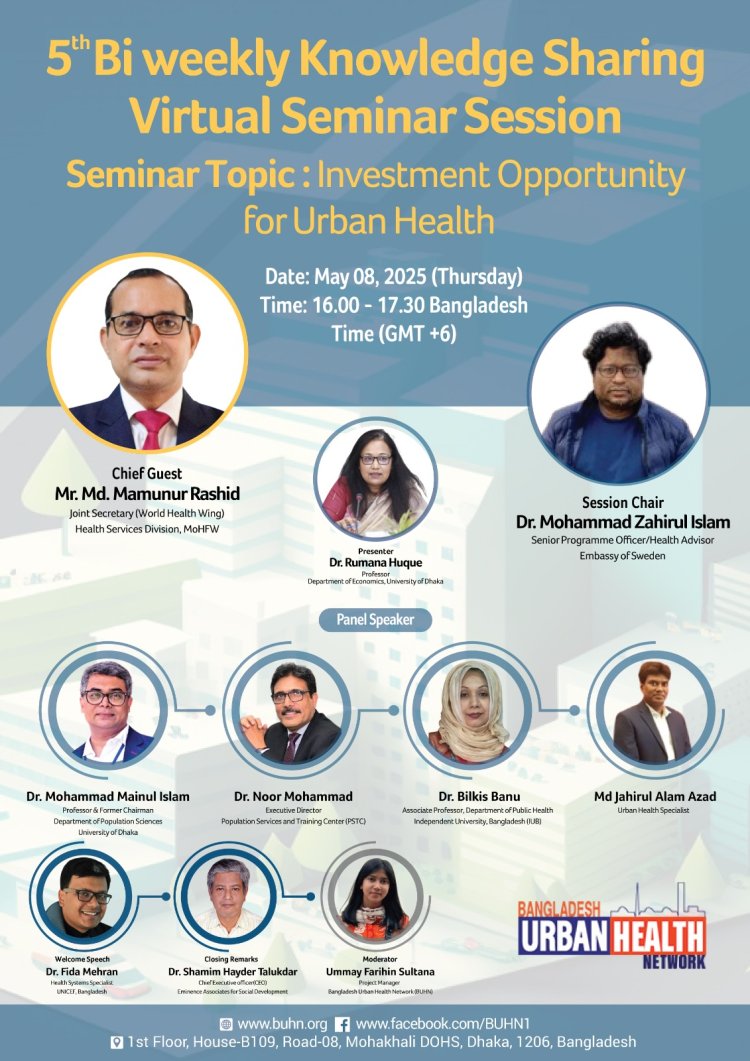
On May 8, 2025, the Bangladesh Urban Health Network (BUHN) hosted its 5th Bi-Weekly Knowledge Sharing Virtual Seminar, titled "Investment Opportunities for Urban Health," via Zoom from 4:00 PM to 5:30 PM BST, moderated by Ummay Farihin Sultana, BUHN Project Manager, to discuss investment prospects in Bangladesh’s urban healthcare sector.
Dr. Fida Mehran, Health System Specialist at UNICEF Bangladesh, delivered the welcome speech, highlighting the inadequacy of medical services faced by poor urban residents due to administrative and resource gaps, financial constraints, and the need for increased government and private investment in primary healthcare, especially as donor organizations phase out support for integrated urban healthcare models.
Dr. Rumana Haque, Professor at the University of Dhaka, presented on investment opportunities, noting challenges from rapid urbanization, with 41% of the population living in urban areas and 35% in slums, high out-of-pocket expenditure (74%), a shortage of hospital beds (0.5 per 1,000), and the impending end of donor-funded primary care by 2025, recommending increased health budgets, strategic purchasing, better provider salaries, scalable digital health, and public-private partnerships.
In the panel discussion, Professor Dr. Mohammad Mainul Islam, Former Chairman of the Department of Population Sciences at the University of Dhaka, emphasized that the growing urban population and climate change threats necessitate essential investments to maintain urban healthcare service quality. Dr. Noor Mohammad, Executive Director of Population Services and Training Center (PSTC), pointed out that one-third of Bangladesh’s slum population lacks healthcare access due to poor inter-ministerial coordination, rising non-communicable diseases, and underfunded primary healthcare, worsened by the suspension of the Shasthyo Surokhsha Karmasuchi (SSK) program, calling for better data integration and equitable healthcare planning. Dr. Bilkis Banu, Associate Professor at Independent University, Bangladesh, advocated for a collaborative approach involving individuals, communities, healthcare providers, and policymakers to address urban health challenges caused by dense living conditions, emphasizing sustainable health facilities and improved health data collection for digital health policies. Md. Zahirul Alam Azad, an urban health expert, stressed the need for a coordinated public-private approach to facilitate private sector investment, similar to the garment sector, and highlighted the potential of digital healthcare infrastructure and telemedicine to enhance service access.
During the open discussion and Q&A session, Dr. Syed Kamrul Islam, Director (PHC & ITHC) at the Directorate General of Health Services (DGHS), underscored the importance of establishing more urban service centers, ensuring door-to-door healthcare, and expanding digital health and telemedicine services. Dr. Md. Shamim Hayder Talukder, BUHN Member Secretary and CEO of Eminence Associates for Social Development, emphasized that substantial investment is crucial for modernizing urban healthcare management, improving coordination between the Ministry of Local Government, Rural Development and Co-operatives (MoLGRD&C) and the Ministry of Health and Family Welfare (MoHFW), and addressing social determinants like housing and food safety.
Md. Mamunur Rashid, Joint Secretary (World Health Branch) at the MoHFW, as the chief guest, highlighted the critical role of private investment and public-private partnerships in strengthening the urban health system, referencing the Health Sector Reform Commission’s report and the need to reduce out-of-pocket expenditure and improve budget efficiency, while acknowledging implementation challenges due to financial and capacity constraints.
Dr. Mohammad Zahirul Islam, Health Advisor at the Embassy of Sweden, as the session chair, urged the government to provide comprehensive support for urban healthcare investment to break the cycle of inadequate spending and address health determinants for economic development.
In his closing remarks, Dr. Md. Shamim Haider Talukder thanked participants, expressed BUHN’s commitment to improving urban healthcare, and notified the International Conference on Urban Health (ICUH) 2025 in New Zealand from November 17-21, with abstracts due by May 17.
The seminar decided to increase investment in urban primary healthcare through diverse funding sources, including government budgets, private sector contributions, and innovative financing mechanisms, to ensure sustainable services as donor support diminishes. It also resolved to expand urban healthcare infrastructure by establishing more service centers, implementing door-to-door and digital health services, and adapting successful rural health models to improve access and quality for slum dwellers and low-income groups. To reduce financial barriers, the seminar recommended strategies like strategic purchasing, health insurance, and targeted subsidies to lower the 74% out-of-pocket expenditure faced by urban residents. Additionally, it called for fostering collaboration among government ministries, private sector partners, and civil society to optimize resources and develop comprehensive urban health strategies. The seminar emphasized investing in digital health technologies and data systems to enhance service delivery, enable telemedicine, and provide robust data for evidence-based policies. It also highlighted the need to address social determinants of health through integrated urban planning tackling housing, nutrition, and environmental factors to complement healthcare investments. In conclusion, the BUHN seminar underscored the urgent need for coordinated, multi-stakeholder efforts to boost investment in Bangladesh’s urban healthcare, leveraging public-private partnerships, digital innovations, and holistic strategies to ensure equitable, sustainable health outcomes for rapidly urbanizing populations.