BUHN Hosts 16th Knowledge Sharing Seminar on Building Resilient Urban Health Systems through Improved Medical Waste Practices
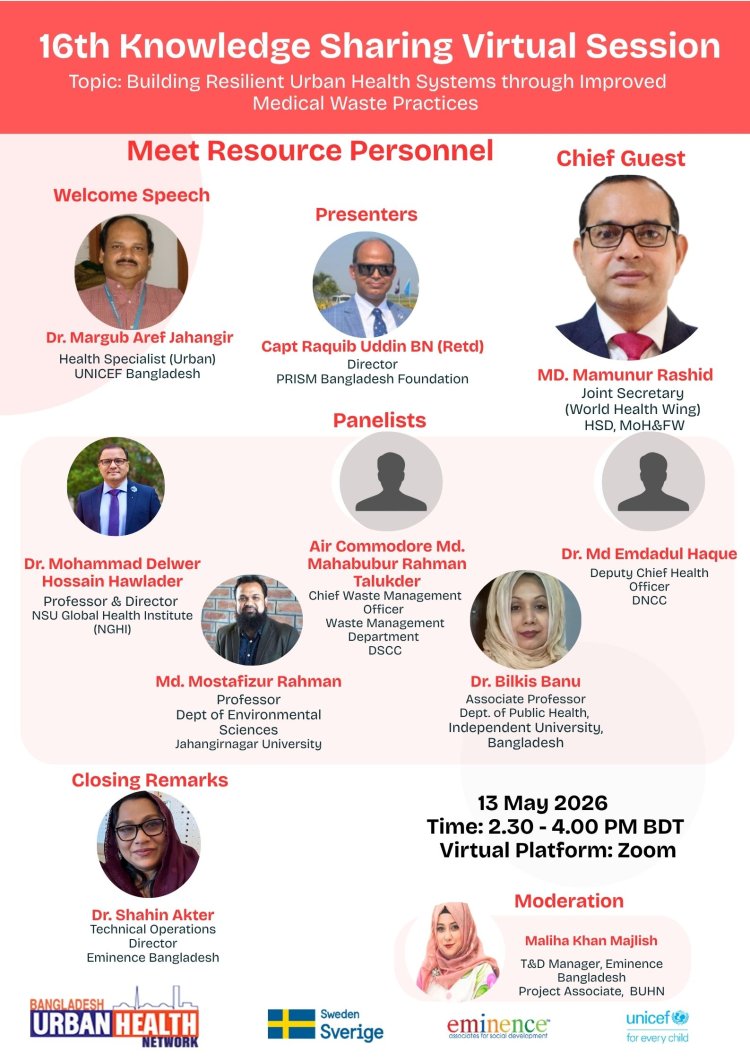
The Bangladesh Urban Health Network (BUHN), with support from UNICEF Bangladesh, successfully organized its 16th Knowledge Sharing Virtual Seminar on 13 May 2026, bringing together senior government officials, development partners, urban health experts, academics, city corporation representatives, and healthcare professionals to discuss "Building Resilient Urban Health Systems through Improved Medical Waste Practices." The virtual seminar served as a national platform for sharing knowledge, experiences, and practical solutions to strengthen healthcare waste management as an essential component of resilient urban health systems in Bangladesh.
The session was inaugurated with welcome remarks by Dr. Margub Aref Jahangir, Health Specialist (Urban), UNICEF Bangladesh, who emphasized that rapid urbanization, increasing healthcare demands, climate-related risks, and environmental degradation have made medical waste management a critical public health and urban governance priority. He highlighted that safe healthcare waste management not only prevents infections and environmental pollution but also strengthens climate resilience and contributes to safer and healthier cities through effective multi-sectoral collaboration.
The keynote presentation was delivered by Captain Raquib Uddin BN (Retired), Director of Prism Bangladesh Foundation (PBF), who provided an overview of Bangladesh's medical waste management landscape and PRISM's pioneering role since 2003 in establishing organized hazardous healthcare waste management systems. He outlined the complete waste management process, including source segregation, collection, barcode tracking, transportation, treatment, and environmentally compliant disposal. The presentation also highlighted the country's legal and regulatory framework, including the Medical Waste Management Rules 2008, while identifying key operational challenges such as inadequate waste segregation, weak regulatory enforcement, insufficient awareness among healthcare workers, limited treatment infrastructure, and financial constraints affecting sustainable operations.
The panel discussion featured distinguished experts including Dr. Md. Dalowar Hossain, Professor and Director of the Global Health Institute; Md. Mahabubur Rahman Talukder, Chief Waste Management Officer, Dhaka South City Corporation (DSCC); Dr. Bilkis Banu, Associate Professor, Department of Public Health, Independent University of Bangladesh; and Dr. Imdadul Haque, District Chief Health Officer, Dhaka North City Corporation (DNCC).
The panelists underscored that effective medical waste management extends beyond technical solutions and requires behavioral change, institutional accountability, strong regulatory enforcement, and sustained investment. They highlighted the importance of integrating waste management education into schools, strengthening healthcare worker training, ensuring mandatory waste segregation at source, and fostering collaboration among healthcare facilities, city corporations, government agencies, private operators, and communities.
During the discussion, Md. Mahabubur Rahman Talukder noted that Bangladesh generates approximately 300 tons of medical waste daily, including nearly 60 tons of hazardous waste, while only about 28 tons are currently managed through formal systems. He emphasized the urgent need to expand standardized medical waste management services across the country's more than 32,000 healthcare facilities and highlighted ongoing efforts by DSCC, DNCC, and PRISM Bangladesh to modernize treatment facilities through expanded infrastructure and advanced technologies.
Reflecting on the broader public health implications, Dr. Bilkis Banu stressed that ineffective medical waste management creates a continuous cycle of environmental contamination and disease transmission. She advocated for a holistic approach involving healthcare institutions, service providers, policymakers, researchers, and academic institutions to develop evidence-based, climate-sensitive, and sustainable solutions tailored to Bangladesh's urban context.
Dr. Imdadul Haque emphasized that resilient healthcare waste management depends on active participation from healthcare providers, municipal authorities, citizens, and waste handlers alike. He reiterated the importance of proper waste segregation, public awareness, and coordinated implementation of safe waste management practices throughout the healthcare system.
The seminar concluded with remarks from Md. Mamunur Rashid, Joint Secretary, WHO Health Section, Health Services Division, Ministry of Health and Family Welfare, who served as the Chief Guest. He emphasized the importance of integrating medical waste management into Bangladesh's national health system and highlighted the ongoing collaboration between the Ministry of Health and Family Welfare and the Ministry of Environment, Forest and Climate Change to strengthen the country's policy framework. He also shared that the Ministry is currently implementing medical waste management initiatives in 15 medical college hospitals and plans to expand these interventions to additional district hospitals as part of developing an integrated national system.
The seminar generated several important recommendations, including strengthening enforcement of the Medical Waste Management Rules, integrating medical waste management into the national healthcare system, ensuring mandatory source segregation and regular training for healthcare workers, expanding services to district hospitals and rural healthcare facilities, strengthening coordination among relevant ministries and city corporations, promoting public awareness and behavioral change, increasing financial and infrastructure support, and encouraging innovation and environmentally sustainable technologies.
The seminar was moderated by Ms. Maliha Khan Majlish, Technical & Development Manager, Eminence Associates for Social Development. The event brought together representatives from the Ministry of Health and Family Welfare, UNICEF Bangladesh, Dhaka North and South City Corporations, Prism Bangladesh Foundation, academia, development partners, and members of the Bangladesh Urban Health Network.
Through this knowledge-sharing initiative, BUHN reaffirmed its commitment to advancing evidence-informed policy dialogue and multi-sectoral collaboration to strengthen urban health systems and promote safer, cleaner, and more resilient cities across Bangladesh.