BUHN Holds 17th Knowledge Sharing Virtual Seminar on Scaling Up Mental Health Interventions in Urban Communities
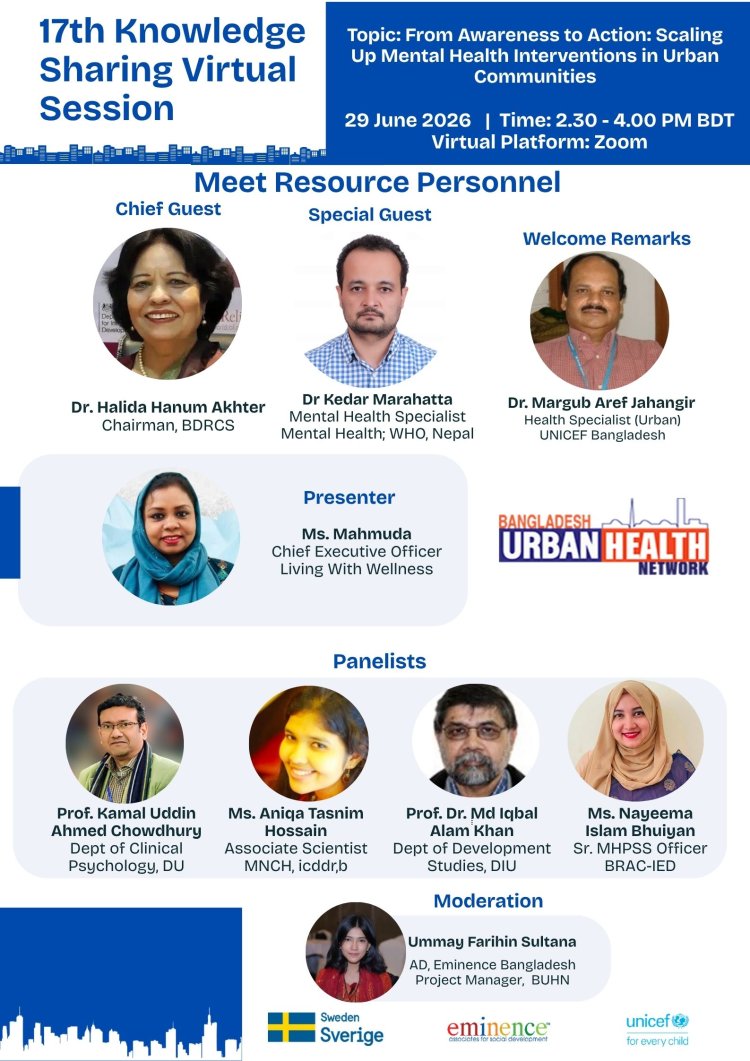
The Bangladesh Urban Health Network (BUHN), supported by UNICEF Bangladesh, successfully organized its 17th Knowledge Sharing Virtual Seminar on 29 June 2026 on the theme, "From Awareness to Action: Scaling Up Mental Health Interventions in Urban Communities." The virtual session brought together senior government officials, international experts, development partners, academics, researchers, mental health practitioners, and civil society representatives to explore practical strategies for strengthening mental health services within Bangladesh's rapidly urbanizing communities.
The seminar provided a timely platform to discuss the growing burden of mental health conditions in urban settings, where rapid urbanization, social isolation, economic hardship, environmental stressors, and climate-related challenges increasingly affect the psychological well-being of communities. Participants emphasized that translating awareness into concrete action requires stronger policy commitment, increased investment, integrated service delivery, and sustained collaboration across sectors.
The session commenced with welcome remarks by Dr. Margub Aref Jahangir, Health Specialist (Urban), UNICEF Bangladesh, who highlighted that mental health is fundamental to overall health and well-being and should be recognized as a key pillar of resilient urban health systems. He noted that while awareness of mental health has grown significantly, millions of people continue to lack access to appropriate care. Stressing the importance of moving beyond awareness campaigns, he called for integrating mental health into primary healthcare, strengthening frontline health workers, reducing stigma, engaging communities, and leveraging digital innovations to improve access to quality mental health services.
The keynote presentation was delivered by Ms. Mahmuda, Chief Executive Officer of Living With Wellness, who outlined the growing mental health challenges associated with rapid urbanization in Bangladesh. She highlighted increasing rates of depression, anxiety, suicide, substance use disorders, and trauma, compounded by the long-term impacts of the COVID-19 pandemic. Presenting the organization's work, she showcased initiatives in psychosocial support, school and workplace mental health promotion, suicide prevention, trauma-informed care, Mental Health and Psychosocial Support (MHPSS) capacity building, and community counselling services for vulnerable populations. She also identified key barriers to expanding mental health services, including shortages of trained professionals, limited financial resources, social stigma, inadequate referral systems, and insufficient implementation of the Mental Health Act 2018. She emphasized the need for multidisciplinary collaboration, increased government investment, stronger digital mental health platforms, and the integration of mental health into primary healthcare.
The panel discussion featured distinguished experts, including Prof. Kamal Uddin Ahmed Chowdhury, Department of Clinical Psychology, University of Dhaka; Ms. Aniqa Tasnim Hossain, Associate Scientist, Maternal and Child Health Division, icddr,b; Prof. Dr. Md. Iqbal Alam Khan, Department of Development Studies, Daffodil International University; and Ms. Nayeema Islam Bhuiyan, Senior MHPSS Officer, BRAC Institute of Educational Development (BRAC-IED).
Sharing evidence from implementation research, Ms. Aniqa Tasnim Hossain presented innovative digital and community-based mental health service models developed through collaboration with the Directorate General of Health Services. She highlighted the Wellbeing Center model, which integrates mental health screening into routine outpatient services and connects patients with psychologists and psychiatrists through tele-counselling and telepsychiatry. She emphasized that sustainable expansion of mental health services requires integration into primary healthcare, standardized referral systems, continuous provider training, and strong government ownership.
Prof. Dr. Md. Iqbal Alam Khan stressed that mental health should be viewed as both a public health and a social development issue. He highlighted the impact of unemployment, financial hardship, social exclusion, and other socioeconomic stressors on psychological well-being and advocated for action-oriented research to inform policy and programme development. He also underscored the growing potential of digital technologies and artificial intelligence in supporting mental health awareness, screening, counselling, and service delivery.
Focusing on workforce development and culturally appropriate care, Prof. Kamal Uddin Ahmed Chowdhury emphasized the urgent need to strengthen Bangladesh's mental health workforce by retaining qualified professionals and expanding training opportunities. He noted that reducing stigma requires promoting positive mental health through schools and educational institutions from an early age and called for culturally adapted interventions that reflect Bangladesh's social realities while maintaining international standards of care.
Drawing on BRAC-IED's extensive experience in community mental health, Ms. Nayeema Islam Bhuiyan highlighted the effectiveness of community-based Mental Health and Psychosocial Support (MHPSS) programmes. She explained how trained community counsellors, supported through mentoring and supervision, provide psychosocial support, facilitate referrals, and expand access to mental health services among vulnerable populations. She also showcased the role of tele-counselling services in improving access while emphasizing that early intervention, positive parenting, and community engagement are critical for promoting lifelong mental well-being.
Joining the session as Special Guest, Dr. Kedar Marahatta, Mental Health Specialist, WHO Nepal, shared regional perspectives on urban mental health challenges across South Asia. He noted that although urban areas often have greater availability of healthcare services, many vulnerable populations continue to face barriers related to affordability, accessibility, and trust in public health services. He advocated for people-centred, equitable, and flexible service delivery models that respond to the needs of working populations, migrants, homeless individuals, and other marginalized groups.
Delivering the Chief Guest's address, Dr. Halida Hanum Akhter, Chairman of the Bangladesh Red Crescent Society (BDRCS), emphasized that Bangladesh's health priorities are increasingly expanding beyond maternal and child health to include mental health, healthy ageing, and overall well-being. She called for integrating mental health into the country's Essential Service Package (ESP), operational plans, and national health budget to ensure sustainable financing and institutional accountability. She also stressed the importance of strengthening the capacity of healthcare providers across all levels of the health system, generating national evidence on mental health, and enhancing policy advocacy to position mental health as a national development priority.
The seminar concluded with a strong consensus on the need to integrate mental health into urban primary healthcare services, strengthen implementation of the Mental Health Act 2018, expand community-based MHPSS programmes, build the capacity of mental health professionals and frontline providers, scale up tele-counselling and digital mental health services, reduce stigma through continuous public awareness campaigns, strengthen multi-sectoral collaboration, and improve mental health data, research, referral systems, and monitoring to support evidence-informed policymaking.
The session was moderated by Ms. Ummay Farihin Sultana, Assistant Director, Department Head of Planning and Development, Eminence Associates for Social Development, and Project Manager of BUHN. The event brought together representatives from UNICEF Bangladesh, Bangladesh Red Crescent Society, WHO Nepal, icddr,b, BRAC Institute of Educational Development, the University of Dhaka, Daffodil International University, Living With Wellness, and other government, academic, and development organizations.
Through this knowledge-sharing initiative, BUHN reaffirmed its commitment to promoting policy dialogue, strengthening partnerships, and advancing evidence-based solutions to integrate mental health into resilient urban health systems. The discussions reinforced the urgent need to move beyond awareness and translate knowledge into coordinated actions that ensure accessible, inclusive, and sustainable mental health services for all urban populations in Bangladesh.