Bangladesh Urban Health Network Hosts 13th Knowledge Sharing Virtual Seminar on “Urban Health and Youth Engagement”
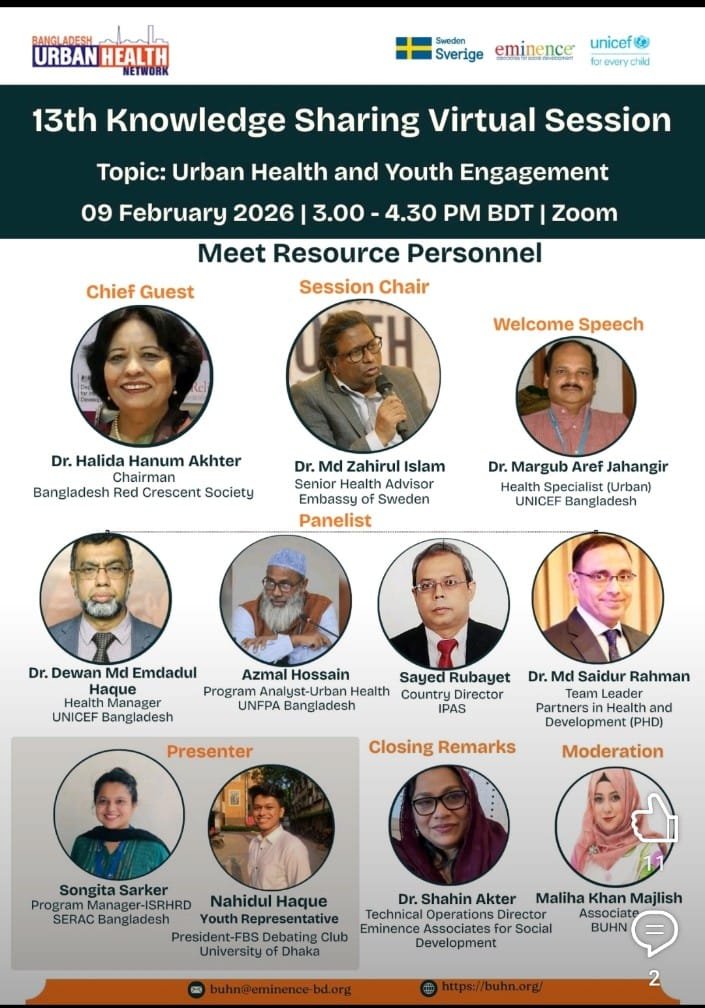
The Bangladesh Urban Health Network (BUHN) successfully convened its 13th Knowledge Sharing Virtual Seminar titled “Urban Health and Youth Engagement” on Monday, 09 February 2026, from 3:00 PM to 4:30 PM (Bangladesh Time, GMT +6). The session brought together senior government representatives, development partners, humanitarian leaders, health experts, academics, youth representatives, and civil society organizations to critically examine the role of young people in advancing equitable and sustainable urban health systems in Bangladesh. The seminar objectives were clearly articulated: to enhance understanding of key urban health challenges and opportunities; to highlight the role and responsibilities of youth in improving urban health outcomes; to explore mechanisms for meaningful youth engagement in community-based initiatives; to facilitate knowledge exchange on policies and best practices; and to inspire youth leadership and structured collaboration for long-term sustainability.
In opening remarks, Dr. Margub Aref Jahangir, Health Specialist (Urban), Health Section, UNICEF Bangladesh, emphasized that Bangladesh’s cities are expanding at an unprecedented pace, creating both economic opportunity and profound health inequities. Urban areas, while centers of innovation and diversity, also reveal stark disparities in access to quality healthcare, nutrition, safe water, sanitation, environmental protection, and mental health services. He underscored that youth must not be viewed solely as beneficiaries of health services, but as strategic partners and drivers of innovation. Young people bring digital literacy, social connectivity, volunteerism, and community-level trust that can significantly strengthen urban primary healthcare delivery and accountability mechanisms. He stressed that structured youth engagement in planning, implementation, and advocacy enhances responsiveness, inclusiveness, and sustainability of urban health interventions.
The first technical presentation was delivered by Songita Sarker, Program Manager at SERAC-Bangladesh. She provided a comprehensive overview of the multidimensional vulnerabilities faced by youth in rapidly urbanizing settings. These include limited access to adolescent-friendly health services, entrenched stigma surrounding sexual and reproductive health and rights (SRHR), high mobility among urban populations, climate-related risks, WASH deficiencies in informal settlements, and weak integration of youth perspectives into municipal planning processes. Despite their vulnerability, youth are frequently excluded from decision-making structures. She presented the Youth Catalyst Initiative as a replicable model that places youth leadership at the center of improving adolescent health, SRHR, nutrition, and climate resilience. The initiative integrates structured mentoring, digital outreach, social media advocacy, policy engagement, and coordinated partnerships with local government and civil society actors. Evidence from program implementation indicates that youth-led outreach improves service uptake, reduces stigma, and strengthens community trust in health systems. The second presentation was delivered by Nahidul Haque Nahin from the University of Dhaka, who offered a youth-led analytical perspective on Dhaka’s urban health realities. He highlighted that extremely high population density—estimated at approximately 26,000 persons per square kilometer—combined with unregulated construction, noise pollution, inadequate sewerage infrastructure, and limited access to safe drinking water, has created a hazardous living environment. Insufficient public sanitation facilities contribute to recurring outbreaks of waterborne diseases such as cholera and diarrhea, particularly during the monsoon season. He further emphasized the critical burden of air pollution, positioning Dhaka among the most polluted cities in South Asia. Beyond physical health, he stressed the systemic neglect of mental health, noting that youth often grow up without access to safe recreational spaces or psychosocial support, contributing to stress, isolation, and diminished well-being. His presentation reinforced the urgent need for integrated urban planning, environmental regulation, and mental health programming within urban health strategies.
The panel discussion deepened the policy and programmatic dialogue. Md. Azmal Hossain, Programme Analyst (Urban Health), described the “dual reality” of urban Bangladesh, where economic growth coexists with structural barriers to healthcare access for marginalized youth. He outlined a three-pronged youth-centered service model: decentralized access points through community pharmacies, workplace SRHR interventions targeting young factory workers, and midwifery-led facility strengthening. These facilities provide antenatal and postnatal care, long-acting reversible contraceptives (LARC), STI screening, post-abortion care, and confidential counseling services. Importantly, the model ensures youth-friendly, non-discriminatory service provision, including private counseling spaces and designated service hours. This integrated approach contributes directly to advancing Sustainable Development Goals (SDG 3 and SDG 11) by aligning health system strengthening with inclusive urban development. Sayed Rubayet, Country Director of IPAS Bangladesh, emphasized strengthening urban SRHR systems through safe menstrual regulation services, post-abortion care, provider capacity development, and stigma reduction initiatives. He highlighted the importance of rights-based, gender-sensitive, and youth-friendly service delivery models. Through policy advocacy and technical support, Ipas contributes to improving quality standards and expanding equitable access to essential reproductive health services in urban areas. Dr. Md. Saidur Rahaman, Team Leader of the Alo Clinic Project, provided evidence of the tangible impact of youth-led community health initiatives. He noted improvements in maternal health awareness, nutrition practices, vaccination coverage, environmental hygiene, and digital engagement strategies when youth are systematically involved. However, he also identified a critical gap: the absence of formal government mechanisms that institutionalize youth participation in urban health governance. He called for clearly defined roles, sustained funding streams, and cross-sector coordination to ensure long-term impact.
The Chief Guest, Dr. Halida Hanum Akhter, Chairman of the Bangladesh Red Crescent Society, highlighted the operational strength of Youth Volunteers across humanitarian and public health domains. She noted their active engagement in disaster preparedness, cyclone response, services within Rohingya camps, blood donation campaigns, mental health support, and community awareness activities. She underscored the disciplined organizational structure of youth volunteers and encouraged expanding training and leadership opportunities to further enhance their contribution to national resilience and public health response systems.
The session was chaired by Dr. Mohammad Zahirul Islam, Health Advisor at the Embassy of Sweden to Bangladesh. He reflected that despite longstanding discussions, youth engagement in health remains insufficiently institutionalized. He identified emerging urban risks affecting youth, including occupational hazards, early marriage, violence, digital addiction, bullying, and environmental exposure. He recommended reactivating youth clubs and establishing well-being platforms within educational institutions, including medical colleges, to foster leadership and accountability in urban health initiatives.
In closing remarks, Dr. Shahin Akhtar, Technical Director at Eminence Associates for Social Development, proposed consolidating seminar outcomes into a formal knowledge product to inform policy dialogue and donor engagement. He emphasized that youth engagement must move beyond consultation toward structured co-creation of programs and accountability frameworks.
The seminar concluded with clear, action-oriented recommendations: formally recognize youth as strategic partners in urban health systems; establish youth-led models addressing mental health, SRHR, nutrition, environmental health, and climate resilience; strengthen capacity through structured training and mentoring; ensure youth-friendly service delivery standards, including privacy and non-discrimination; develop coordinated initiatives under BUHN leadership; and integrate youth into planning, implementation, and advocacy processes at municipal and national levels.
The 13th Knowledge Sharing Virtual Seminar reinforced that youth engagement is not an auxiliary component but a central pillar of inclusive urban health governance. By fostering cross-sector collaboration, evidence-based programming, and institutional commitment, BUHN continues to facilitate high-level dialogue and practical solutions to strengthen Bangladesh’s urban health systems in alignment with national priorities and global development commitments.