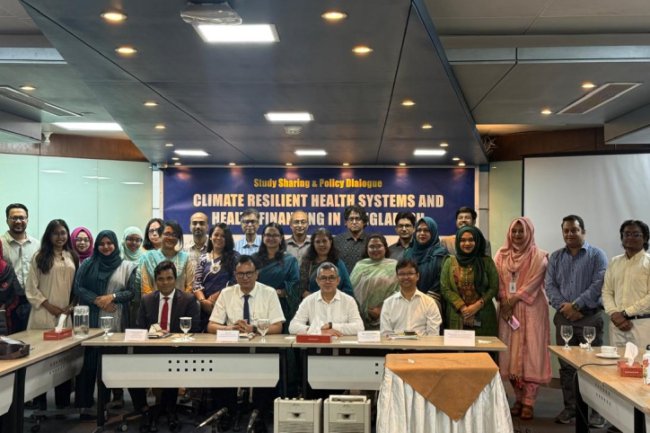
National Policy Dialogue on Urban Health and Private Sector Engagement - Organized by the Bangladesh Urban Health Network (BUHN) | Supported by UNICEF Bangladesh and the Embassy of Sweden

Bangladesh’s urban health landscape continues to face mounting challenges as rapid urbanization outpaces health service provision. With over 41 percent of the population now residing in urban areas, healthcare delivery has become increasingly fragmented due to overlapping responsibilities between the Ministry of Health and Family Welfare (MoHFW) and the Ministry of Local Government, Rural Development, and Cooperatives (MoLGRD&C). Despite several initiatives such as the Urban Primary Health Care Service Delivery Project (UPHCSDP) and the Bangladesh Smiling Sun Franchise Program, urban healthcare remains underfunded and heavily reliant on external support. The private sector, which operates around 60 percent of healthcare facilities nationwide, plays a pivotal role but remains largely unregulated—leading to high out-of-pocket expenditures that push millions into poverty each year. Recognizing these challenges, the Bangladesh Urban Health Network (BUHN) convened a National Policy Dialogue on “Urban Health and Private Sector Engagement” on September 22, 2025, at the Dr. Cecep Effendi Conference Hall, CIRDAP, Dhaka. The dialogue aimed to identify strategies for effective collaboration between public and private sectors to strengthen primary healthcare (PHC) delivery, ensure equitable access to essential medicines, and advance progress toward Universal Health Coverage (UHC).
The session was moderated by Dr. Kazi Saifuddin Bennoor, Senior Consultant at United Hospital, Dhaka, and Convener of Sushasther Bangladesh. The dialogue brought together high-level policymakers, development partners, health experts, and civil society representatives to discuss pragmatic approaches for urban health system reform and sustainable financing models.
In the welcome speech, Dr. Margub Aref Jahangir, Health Specialist (Urban) at UNICEF Bangladesh, highlighted that Bangladesh’s growing urban population presents both opportunities and challenges for ensuring accessible and equitable healthcare. He emphasized that health is a fundamental right, not a privilege, and that the private sector, which delivers 60 percent of services, must be integrated transparently into national health strategies. He cited the Aalo Clinic as an exemplary public-private partnership model and called for greater accountability, emphasizing that no child, mother, or family should be left behind in accessing quality care.
In the first keynote address, Dr. Md. Shamim Hayder Talukder, CEO of Eminence Associates for Social Development and Member Secretary of BUHN, underscored the private sector’s indispensable role in expanding accessibility, introducing digital innovations, and filling service gaps left by the government. Presenting data that revealed stark inequities - only 66 percent of urban children receive healthcare compared to 95 percent in rural areas. Dr. Talukder called for result-based financing mechanisms, formal recognition of private providers, and strengthened data systems. Drawing on successful models from India, Kenya, and Thailand, he urged for joint government-private coordination to overcome service fragmentation and quality concerns.
The second keynote, delivered by Dr. Ahmed Ehsanur Rahman, Scientist at icddr,b and Member of the Health Sector Reform Commission, examined the acute gaps in medicine availability and healthcare access in urban slums. He revealed that 34 percent of under-five children in slum areas were stunted, compared to 22 percent in rural areas, and that many urban hospitals lacked essential medicines such as oxytocin and amoxicillin. He called for urgent reforms to bridge these disparities and to strengthen urban health systems through equitable distribution of medicines and resources.
Among the special guests, Dr. Ziauddin Hyder, advisor to the BNP chairperson and former World Bank nutrition expert, proposed introducing a universal health card that would integrate patient management across public and private sectors. He emphasized reforms in emergency services, medical negligence laws, and regulation of caesarean deliveries, urging that urban health be brought under the direct jurisdiction of the Ministry of Health. Prof. Dr. Sayeba Akhter, President of the Bangladesh Medical Research Council, echoed the need for stronger political commitment and increased health sector budgets. She lamented the lack of implementation of reform commission recommendations, noting that while the health sector is structurally strong, it remains functionally weak.
The Chief Guest, Dr. Hossain Zillur Rahman, Executive Chairman of the Power and Participation Research Centre (PPRC), presented a powerful economic perspective. Citing PPRC’s findings that 52 percent of Bangladeshi households include at least one chronically ill patient requiring long-term medication, he stressed the urgent need for a healthcare safety net akin to existing social protection programs. Dr. Rahman warned that the country could no longer afford slow progress and suggested that simply filling 40 percent of vacant posts in the health sector could yield major improvements without additional reforms.
The Session Chair and representing development partners, Dr. Mohammad Zahirul Islam, Senior Programme Officer and Health Advisor at the Embassy of Sweden, highlighted that Bangladesh’s loosely regulated private sector had led to an unplanned proliferation of pharmacies and diagnostic centers. He urged the government to define service provision frameworks, enforce accreditation, and pursue integrated Universal Health Coverage through joint engagement of public, private, and community actors.
During the open discussion, several prominent experts shared actionable insights. Dr. Zeba Mahmud of the Micronutrient Initiative emphasized preventive healthcare and community education, especially for women. Prof. Dr. Farhana Dewan of OGSB called for stricter regulation and improved prescription practices to ensure medicine quality. Prof. Dr. Shakhawat Hossain Sayantha of Bangladesh Medical University cautioned that governance failures and corruption were obstructing policy implementation, while Dr. Nizam Uddin Ahmed of the GAVI CSO Steering Committee urged the Ministry of Health to assume full responsibility for urban health management and curb pharmaceutical companies’ unethical promotional practices.
Dr. Arif Mahmud of Evercare Hospital pointed out the severe shortage of human resources - only 100,000 nurses against a need for 300,000 and called for clear PPP frameworks, health insurance, and digital health records. Prof. Syed Abdul Hamid of Dhaka University’s Institute of Health Economics advocated for a unified health authority covering both urban and rural areas to manage strategic purchasing and PPPs effectively. Dr. Fida Mehran of UNICEF added that urban health should integrate environmental and climate resilience dimensions, while Prof. Dr. Syed Md. Akram Hussain from Bangladesh Medical University stressed enacting an ordinance to empower the Health Reform Commission to implement overdue reforms.
Other contributors, including Dr. Sharmin Mizan of MoLGRD&C, highlighted ongoing cost-sharing strategies between city corporations and NGOs to sustain primary healthcare services. Prof. Dr. Saria Tasnim from OGSB and Ms. Masuda Begum from Nari Maitree emphasized the need for better alignment between health education and service delivery, and for policymakers to design urban-specific service schedules. Brig. Gen. (Retd.) Dr. Md. Saidur Rahman from the Aalo Clinics project advocated for a legal framework to institutionalize PPP models, while Ms. Khondker Rebaka Sun Yat from the Coalition for Urban Poor stressed mobilizing Corporate Social Responsibility (CSR) funding to sustain healthcare for low-income populations. Dr. Md. Mahbubul Alam of PSTC underscored the urgency of securing post-2025 financing for projects like Surjer Hashi Clinic and UPHCSDP to prevent service disruptions.
The key recommendations from the dialogue were comprehensive and actionable. Participants urged the creation of a sustainable financing framework integrating result-based financing, PPPs, and CSR contributions to ensure long-term funding for primary healthcare especially for the urban poor. Mandatory accreditation for private facilities and stricter regulation of pharmacies and diagnostic centers were recommended to curb unregulated expansion and control medicine prices. Addressing the acute human resource gap by filling 40 percent of vacant positions and strengthening ethical prescription training were seen as urgent priorities. The introduction of universal health cards, digital health records, and health insurance schemes was also emphasized to bridge urban-rural inequities and enhance transparency. Finally, participants called for increased health budget allocations, urban-focused research, and strong political commitment ahead of national elections to embed health as a central development priority.
In conclusion, the National Policy Dialogue on Urban Health and Private Sector Engagement provided a critical platform for aligning stakeholders around a shared vision for equitable, efficient, and sustainable urban healthcare in Bangladesh. The discussions revealed that the country possesses a robust policy foundation but lacks functional coordination, implementation capacity, and sustainable financing. Effective public-private collaboration, backed by political will, adequate investment, and strong accountability, emerged as the linchpin for realizing Universal Health Coverage in urban Bangladesh. Moving forward, institutionalizing PPPs, leveraging CSR, and empowering the Health Sector Reform Commission could transform Bangladesh’s fragmented urban health landscape into an inclusive system that ensures no one is left behind.