Public–Private Partnerships Emerge as Critical Lever for Equitable Urban Health in Bangladesh
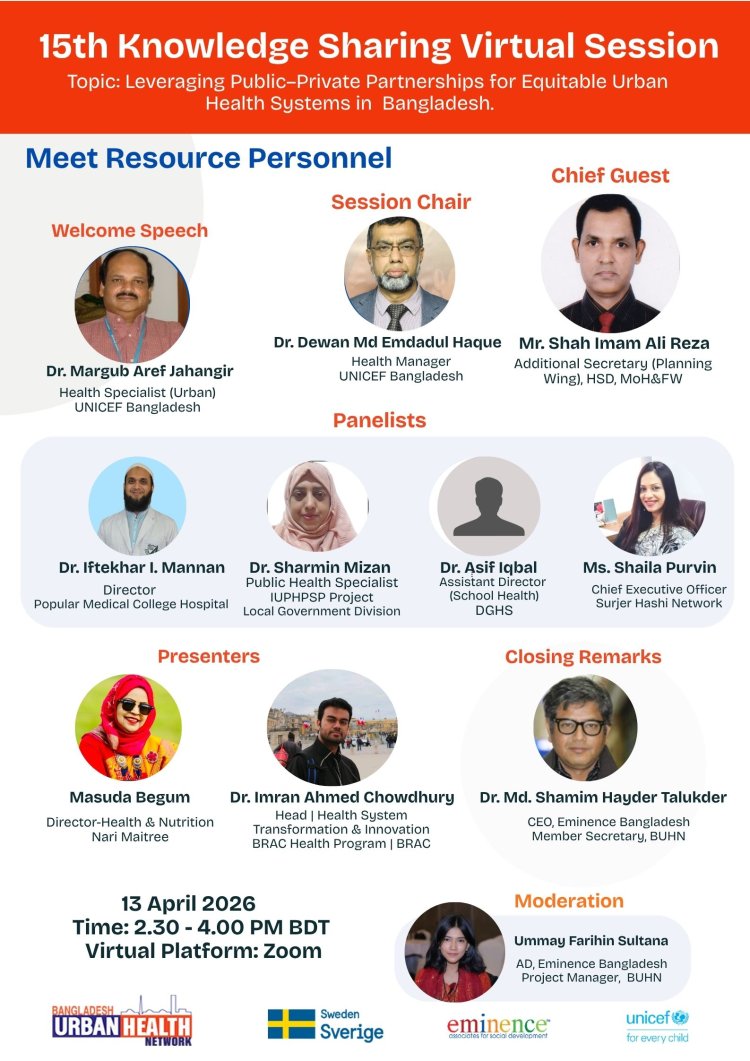
With rapid urbanization reshaping Bangladesh’s demographic and health landscape, leading policymakers, development partners, and health experts have underscored the urgent need to reposition Public–Private Partnerships (PPPs) as a central pillar of urban health reform. This consensus emerged from the 15th Knowledge Sharing Virtual Seminar hosted by the Bangladesh Urban Health Network (BUHN), in collaboration with key stakeholders including UNICEF Bangladesh, bringing together representatives from government, private sector, academia, and civil society.
The high-level dialogue highlighted that although urban areas contribute significantly to national economic growth, access to quality healthcare remains deeply unequal. With nearly half of the population now residing in cities, marginalized groups, particularly those living in informal settlements, continue to face limited access to affordable and quality services. Participants noted that high out-of-pocket health expenditures, estimated at over two-thirds of total health spending, continue to place a disproportionate burden on low-income households, while service coverage gaps, including lower immunization rates in urban poor communities, reflect systemic inequities.
Speakers emphasized that while PPPs already play a substantial role in Bangladesh’s urban health system, particularly through NGOs, private clinics, and diagnostic services, these efforts remain fragmented and often project-based. There was strong agreement on the need to transition from isolated pilot initiatives to a more structured and integrated “system architecture” that aligns public sector leadership with private sector efficiency and innovation. Experiences from large-scale urban primary healthcare programs were cited as evidence that well-designed partnerships can significantly expand access, improve quality, and enhance efficiency when implemented within a coherent framework.
However, the discussion also brought attention to persistent governance and coordination challenges, particularly between the Ministry of Health and Family Welfare and local government institutions responsible for urban service delivery. This institutional fragmentation continues to hinder effective planning, contracting, and monitoring of health services. Experts stressed that without strong regulatory frameworks, clear contractual arrangements, and robust accountability mechanisms, PPP initiatives risk exacerbating inequities rather than addressing them.
Balancing cost, quality, and equity emerged as a critical concern. While PPP models offer opportunities to leverage private sector capacity in both primary and tertiary care, participants cautioned against rising service costs and variability in quality. Lessons from regional experiences demonstrated that models such as private management of public facilities or government contracting of specialized services can be effective, but require realistic financing structures, transparent agreements, and strong oversight to ensure sustainability. Ensuring that PPPs are explicitly designed to benefit the urban poor, through subsidies, voucher schemes, and community outreach, was highlighted as essential.
The seminar further emphasized that improving urban health outcomes requires a multi-sectoral approach that extends beyond healthcare delivery. Participants noted that factors such as housing conditions, sanitation, environmental quality, and transport systems significantly influence health outcomes in urban settings. As such, effective PPP strategies must be integrated within broader urban governance frameworks, engaging multiple sectors and stakeholders in a coordinated manner.
Financing and digital innovation were identified as key enablers for scaling PPPs. Stakeholders called for the development of sustainable financing mechanisms, including innovative and risk-sharing models aligned with Universal Health Coverage (UHC) goals. At the same time, strengthening digital health infrastructure, particularly through integration with national health information systems, was seen as critical for enhancing transparency, enabling real-time data sharing, and improving service delivery and emergency response capacities.
High-level policy commitment to advancing PPPs was also reaffirmed during the session, with government representatives highlighting ongoing efforts to strengthen urban health governance and explore new partnership models. Development partners reiterated the importance of long-term investment in system strengthening, governance, and inclusive service delivery to ensure that PPPs contribute meaningfully to national health goals.
The seminar concluded with a strong call to expand PPPs beyond their current focus on tertiary care and integrate them more effectively into urban primary healthcare systems, where the needs of vulnerable populations are most acute. Recommendations included strengthening regulatory and policy frameworks, enhancing coordination between national and local authorities, institutionalizing quality assurance and accountability systems, and sustaining multi-stakeholder dialogue to support long-term reform.
As Bangladesh continues to navigate the challenges of rapid urbanization, the discussions reinforced a clear and compelling message: strategically designed and well-governed Public–Private Partnerships are essential to building an equitable, inclusive, and resilient urban health system that leaves no one behind.