11th Knowledge Sharing Virtual Seminar Session on Nutrition and Urban Health

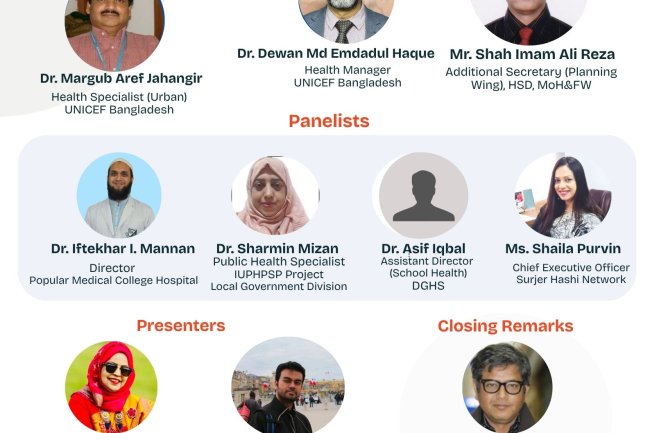
The 11th Knowledge Sharing Virtual Seminar Session, hosted by the Bangladesh Urban Health Network (BUHN) on November 12, 2025, focused critically on "Nutrition and Urban Health," addressing the intensifying challenge of urban malnutrition fueled by rapid urbanization and concurrent lifestyle shifts. The session, moderated by Maliha Khan Majlish, Project Associate at BUHN and featuring Chief Guest Dr. Md. Rizwanur Rahman, Director General of Bangladesh National Nutrition Council, aimed to explore how urbanization fundamentally reshapes food environments, share evidence on nutrition transitions, and disseminate findings on food quality and safety in low-income urban areas. The consensus among the key resource personnel, including representatives from UNICEF, IPHN, and BFSA, was the urgent need for robust, multi-sectoral, and integrated approaches to create resilient urban health systems.
Dr. Margub Aref Jahangir, Health Specialist (Urban), Health Section, UNICEF Bangladesh, initiated the discussion by underscoring the necessity of strengthening nutrition-sensitive services within urban primary healthcare, citing integrated models like the UNICEF-supported Aalo Clinic as effective, people-centered approaches.
Following this, Dr. Monira Parveen, Nutrition Officer at UNICEF Bangladesh, presented a detailed account of the "Mothers at Work initiative," a flagship program supporting maternity rights and promoting breastfeeding, particularly within the Ready-Made Garment (RMG) sector. Despite an evaluation showing high awareness of paid maternity leave and breastfeeding standards, Dr. Parveen noted that actual utilization of dedicated breastfeeding spaces and breaks remains low, although factories largely comply with labor policies and wage deductions for breaks are not a widespread issue. Crucially, the program demonstrated a significant economic return of $12 for every dollar invested, leading to a strong recommendation for its expansion beyond the RMG sector, coupled with enhanced monitoring and improved daycare services to boost usage.
Addressing the broader social determinants of health, S M Shaikat, Executive Director of SERAC-Bangladesh, highlighted issues of food insecurity and inequality, especially impacting vulnerable groups like street children. He advocated for a "smart fiscal policy with a human face" to make nutritious food affordable while disincentivizing unhealthy consumption, simultaneously stressing the essential role of integrating nutrition considerations directly into urban planning and actively fostering youth leadership as co-creators of sustainable solutions.
During the open discussion session, Dr. Shahin Akter, Technical Operation Director, Eminence Associates for Social Development, raised a question about potential conflicts between work targets and breastfeeding breaks. In response, Dr. Monira Parveen, Nutrition Officer at UNICEF Bangladesh, clarified that there were no widespread issues of wage deductions for taking breaks, noting that factories are now largely compliant with labor policies. She noted that while awareness of breastfeeding standards was relatively high (around 80–90%), actual utilization of lactation centers remained low.
Special Guests Dr. Mohammed Eunus Ali, Director of the Institute of Public Health Nutrition (IPHN) and Dr. Mohammad Mostafa, Member (Public Health Nutrition), Bangladesh Food Safety Authority (BFSA), provided systemic perspectives on governance and infrastructure gaps. Dr. Mohammed Eunus Ali pointed out the critical shortage of structured urban health facilities and trained human resources compared to rural settings, emphasizing the immediate need to integrate urban health and nutrition services and strengthen related policies in collaboration with the BNNC. Similarly, Dr. Mohammad Mostafa highlighted the ongoing difficulties in ensuring safe and nutritious food for all urban residents, particularly the less privileged, calling for intensified city-level enforcement of food safety measures and robust multi-sectoral coordination across government, civil society, and the private sector.
Chief Guest Dr. Md. Rizwanur Rahman, Director General, Bangladesh National Nutrition Council (BNNC), reinforced these strategies, emphasizing that effective partnerships and shared responsibility are paramount to promoting safe food systems and creating nutrition-sensitive urban environments.
Dr. Md. Shamim Hayder Talukder, CEO of Eminence Associates for Social Development and Member Secretary of BUHN, concluded the seminar by emphasizing that food and nutrition are key to public health in Bangladesh, particularly in addressing the double burden of disease and preventing non-communicable diseases linked to dietary habits and food safety.
The critical takeaways from the seminar crystallized into decisive action points, emphasizing the need to scale up integrated health models like the Aalo Clinic, extend workplace maternity support to all urban workplaces, tighten food safety governance through city-level enforcement, craft inclusive food policies (smart fiscal measures) to ensure equitable access to nutritious food, weave nutrition into urban planning alongside youth engagement, and invest substantially in capacity building by increasing trained human resources and facility readiness across the urban health ecosystem; these concerted actions are designed to guide collaborative efforts toward forging healthier, more inclusive, and resilient urban centers in Bangladesh.