BUHN Participated in Research Dissemination Seminar on Strengthening Pandemic Preparedness for Working Women in Urban Bangladesh
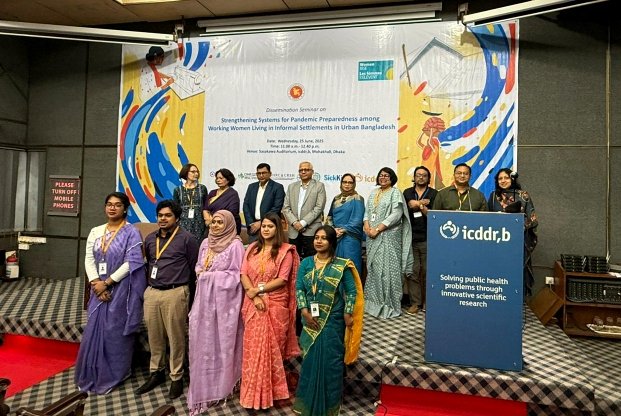
icddr,b, in collaboration with the Institute of Epidemiology, Disease Control and Research IEDCR, the Ministry of Health and Family Welfare (MoHFW), and SickKids, Canada, with funding support from the International Development Research Centre IDRC, Canada, hosted a research dissemination seminar titled "Strengthening Systems for Pandemic Preparedness among Working Women Living in Informal Settlements in Urban Bangladesh." The event, held on June 25, 2025 at the Sasakawa Auditorium, icddr,b, Mohakhali, Dhaka, brought together key stakeholders to discuss the findings and policy implications of the Women RISE study.
The Women RISE study, led by Dr Sohana Shafique (Principal Invesigator), Project Coordinator, HSPSD, icddr,b, employed a sequential mixed-methods implementation research approach to examine the experiences of working women in informal settlements and factories before and during the COVID-19 pandemic and its recovery. Conducted across icddr,b’s Urban Health and Demographic Surveillance System (UHDSS) sites in Dhaka and Gazipur, and six selected ready-made garment RMG factories located in Gazipur, the research focused on understanding how gender, work, and health intersect in low-resource urban contexts. The project applied systems thinking and gender-transformative approaches at micro, meso, and macro levels to co-create and evaluate a tailored intervention package aimed at strengthening pandemic preparedness.
The programme commenced with a welcome speech from Dr Tahmeed Ahmed, Executive Director of icddr,b. He said,” I believe the results of this study will help all of us to prepare for any impending pandemic. We should be careful now that the waves of COVID-19 is increasing. Again, providing us with further refining and embellishing what we have been doing.”
Following the welcome, Dr Sohana Shafique presented the study's key findings, highlighting the vulnerabilities faced by working women in slum communities and factories, existing systemic gaps in urban health services, and the positive impact of the targeted interventions. The COVID-19 pandemic has directly affected the health of women and men, as well as maternal, newborn, and child health, nutrition, mental health, and overall well-being. A 28-year-old domestic worker in Mirpur slum shared how childbirth expenses during the pandemic forced her to sell earrings and take a loan, leading her to discontinue her daughter's schooling. Indirect impacts also included reduced employment and increased food and social insecurity. Over 90% of working women in Bangladesh are employed in the informal sector, which was particularly hard-hit.
The intervention demonstrated significant improvements in various areas. Knowledge regarding respiratory infection exposure routes increased by 29.59% overall, with a 36.28% rise among informal sector workers. Knowledge of symptoms improved by 24.71% overall, showing a 31.61% increase for formal sector workers and 19.60% for informal sector workers. Knowledge of preventive measures increased by 21.24% overall, with both formal 18.25% and informal 23.43% sector workers benefiting. Knowledge on key moments for handwashing also saw increases for both formal 24.70% and informal 27.66% workers. The reported practice of preventive measures also improved by 15.95% overall, with improvements in both formal 16.97% and informal 15.41% sectors. Dietary diversity among working women increased by 11.58% overall, notably by 22.30% for formal sector workers. Furthermore, knowledge of Social Safety Net Programs SSNP registration increased by 16.26% for informal sector workers, and knowledge of Gender-Based Violence GBV services increased by 23.43% overall, with increases for both formal 15.50% and informal 28.51% sector workers.
Mr Mohammad Nora Alam Siddique, Honourable Additional Secretary, of Medical Education and Family Welfare Division, MoHFW, GoB, and Dr Halida Hanum Akhter, Honourable Member of the Women Affairs Reform Commission, GoB and Senior Faculty, Johns Hopkins University, USA, attended the event.
Mr Md. Siddique said, “I request to send these findings to policymakers so that we can check our initiative. MoHFW is committed to collaborating with the cross-sectional groups to improve the systems.”
Dr Sarah Salway, Senior Director of the Health Systems and Population Studies Division, icddr,b, delivered the vote of thanks. Professor Dr Tahmina Shirin, Director of IEDCR and Co-Principal Investigator of the study, provided closing remarks, underscoring the importance of evidence-based, collaborative approaches for future pandemic resilience. Also, strengthening the capacity of the government stakeholders and improving coverage of social protection targeting urban poor working women came as recommendations.