Committee Meeting of Bangladesh Urban Health Network: BUHN Selected its New President and Sets Strategic Directions for Urban Health Advancement in Bangladesh

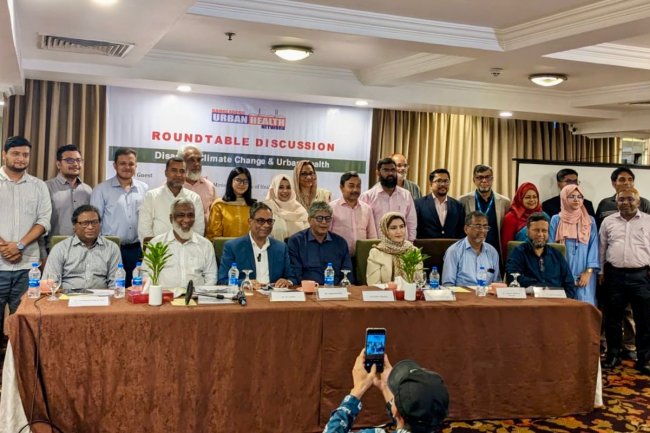
The Bangladesh Urban Health Network (BUHN) convened its Committee Meeting on Sunday, 9 November 2025, from 11:00 AM to 1:00 PM at the UNICEF Office in Agargaon, Dhaka, bringing together representatives from government offices, partner organizations, and network members to review progress, discuss ongoing initiatives, and plan future activities aimed at strengthening the urban health landscape of Bangladesh. The meeting served as a key milestone for BUHN, marking the selection of a new president, outlining major national and international engagements, and reinforcing the network’s growing role as a national platform for knowledge-sharing, policy advocacy, and multisectoral coordination in urban health.
The meeting opened with welcoming remarks from Dr. Khairul Islam, Regional Director of WaterAid South Asia and President of BUHN. He underscored the urgent need to revitalize BUHN’s activities and expand engagement across sectors to enhance the network’s credibility and attract stronger collaboration from stakeholders and development partners. His remarks set the tone for a forward-looking session focused on strengthening BUHN’s institutional structure, expanding its visibility, and escalating its influence in shaping the urban health agenda in Bangladesh.
An update on BUHN’s ongoing activities was presented by Ms. Maliha Khan Majlish, Project Associate at BUHN, who highlighted recent achievements that have significantly elevated the platform’s visibility. The network’s upgraded website, growing social media footprint, timely newsletters, infographics, and various publications were cited as important tools that have helped BUHN reach a wider audience. She emphasized BUHN’s progress in policy dialogue, observance day activities, and international recognition — particularly the acceptance of multiple abstracts and the approval of a panel session at the International Conference on Urban Health (ICUH) 2025. These achievements reflect BUHN’s increasing presence in global urban health discussions.
A major highlight of the meeting was the formation of the new BUHN Committee for the next term. Dr. Khairul Islam formally proposed Dr. Mohammad Zahirul Islam, Senior Programme Officer and Health Advisor at the Development Cooperation Section of the Embassy of Sweden, as the new President of BUHN. The committee unanimously endorsed the proposal, confirming Dr. Zahirul Islam as the President for the next two years. The members also agreed that all other committee members would continue in their existing roles, while Dr. Khairul Islam will continue contributing as an Executive Committee member. The leadership transition was viewed as a strategic move to help BUHN expand its influence through strengthened partnerships with bilateral and multilateral organizations.
Another key agenda item focused on organizing the National Urban Health Conference 2026 and an upcoming International Conference on Urban Health in Bangladesh. Dr. Md. Shamim Hayder Talukder, Chief Executive Officer of Eminence Associates for Social Development and BUHN Member Secretary, highlighted BUHN’s long-term vision of hosting an annual national urban health conference as a flagship event. He informed members about BUHN’s intent to collaborate closely with the newly elected government for increased policy attention and resource mobilization. Dr. Mohammad Zahirul Islam emphasized that scheduling the National Urban Health Conference 2026 after the national election will ensure higher political commitment and broader stakeholder participation from the highest levels of government.
The meeting also discussed BUHN’s participation in the International Conference on Urban Health (ICUH) 2025 in Wellington, New Zealand, scheduled for 17–21 November 2025. Dr. Shamim shared that BUHN will participate in a Special Session titled “Delivering Sustainable Urban Primary Healthcare Services,” co-organized with the Asian Development Bank (ADB). Mr. Rui Liu, Health Specialist at ADB, confirmed high-level participation from Bangladesh, including senior officials from the Health Services Division of the Ministry of Health and Family Welfare (MoHFW), the Economic Relations Division, and two Joint Secretaries from Local Government and Health Services Divisions. The session is expected to strengthen coordination between MoHFW and the Local Government Division, enhancing service delivery within the urban primary healthcare system.
Expanding BUHN’s membership and partnership network also received significant attention. Dr. Shamim emphasized the need for a stronger and broader membership base, extending BUHN’s reach beyond Dhaka to divisional and city levels. He suggested forming divisional subcommittees to monitor and strengthen urban health activities locally. Members agreed that widening the network would foster localized action, broaden stakeholder engagement, and enhance data flow from the field.
During the open discussion, several strategic insights were shared by members and partners. Mr. Rui Liu noted that the current ADB Primary Healthcare Project, scheduled to conclude in December 2025, is establishing 194 primary healthcare centers across Bangladesh. He emphasized that allocating 50% of the project’s cost to human resources underscored the critical importance of staffing these facilities with qualified personnel. He added that MoHFW’s commitment to deploying personnel would significantly enhance the impact of these centers, and the next phase of the project, expected by 2027, should focus on sustainability.
Dr. Khairul Islam stressed the need for future phases of urban health programs to adopt output-based or results-based approaches and encouraged greater NGO engagement in service delivery. Similarly, Dr. Margub Aref Jahangir, Health Specialist (Urban) at UNICEF Bangladesh, advocated for replicating the output-based service model demonstrated by the Aalo Clinic model. Dr. Zahirul Islam recommended organizing a seminar and a roundtable before the national election to brief political parties on urban health priorities, urging them to reflect these priorities in their election manifestos.
Former Health Secretary Md. Ashadul Islam highlighted the importance of setting clear priorities and working systematically toward tangible achievements. Responding to these suggestions, Dr. Shamim proposed holding the seminar in the third week of December 2025 and the roundtable in the second week of January 2026. He also confirmed that the next BUHN Committee Meeting will be held on 7 December 2025, ideally at the ADB Office, with UNICEF Bangladesh as an alternative venue.
The meeting concluded with closing remarks from Dr. Khairul Islam, who thanked all participants and emphasized that Bangladesh’s urban health challenges require renewed focus, strong coordination, and strategic planning. He noted that the meeting’s outcomes represent an important step toward strengthening BUHN as a national platform capable of catalyzing meaningful action in the urban health sector.