BUHN 7th Virtual Seminar on Information Technology (IT) and Artificial Intelligence (AI) in Urban Health
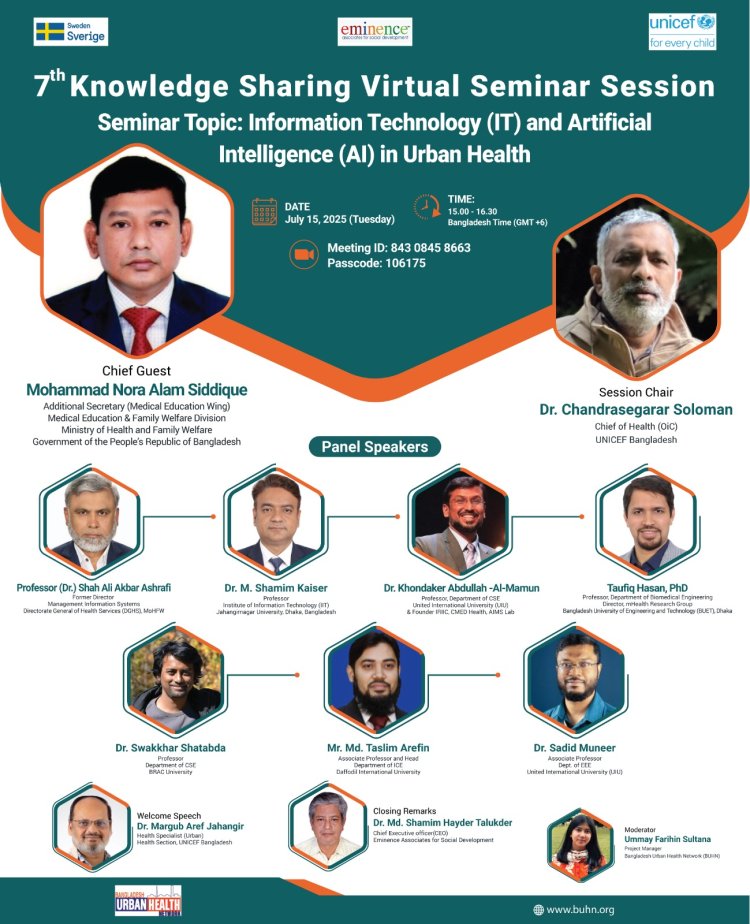
On July 15, 2025, the Bangladesh Urban Health Network (BUHN) successfully hosted its 7th Bi-Weekly Knowledge Sharing Virtual Seminar on the transformative role of Information Technology (IT) and Artificial Intelligence (AI) in strengthening urban health systems in Bangladesh. Held via Zoom, the session was moderated by Ummay Farihin Sultana, Project Manager at BUHN, and brought together national and international experts, government officials, and academicians to deliberate on innovations, opportunities, and the way forward for digital urban health.
The seminar opened with a welcome speech by Dr. Margub Aref Jahangir, Health Specialist (Urban), UNICEF Bangladesh. He emphasized the urgent need for digital transformation in urban health to address fragmented and under-resourced health systems. Dr. Jahangir highlighted the importance of developing a comprehensive national strategy to ensure the ethical, equitable, and accountable scaling of digital health solutions across the country’s growing urban areas.
The panel discussion featured insights from prominent experts in health informatics, AI, and digital health innovation. Professor (Dr.) Shah Ali Akbar Ashrafi, Former Director of MIS at DGHS, Ministry of Health and Family Welfare (MoHFW), discussed the critical role of IT and AI in enabling real-time data monitoring, predictive analytics, and informed policy-making to improve healthcare delivery in urban settings. Dr. Khondaker Abdullah Al-Mamun, Professor at United International University and Founder of IRIIC, CMED Health, and AIMS Lab, presented his work on developing AI and IoT-powered intelligent general practitioner models to deliver personalized, community-level healthcare.
Continuing the discussion, Dr. M. Shamim Kaiser, Professor at the Institute of Information Technology, Jahangirnagar University, called for the urgent integration of AI and ICT into urban health services to enhance efficiency, accessibility, and decision-making processes. Dipto Biswas, Senior Lecturer, Department of ICE at Daffodil International University, shared research on wireless body area networks and digital content analysis, emphasizing the importance of stakeholder mapping, improved coordination, and data-driven policymaking to bridge urban health system gaps. Dr. Taufiq Hasan, Professor of Biomedical Engineering at BUET and Director of the mHealth Research Group, highlighted several innovative, low-cost AI applications, such as dengue outbreak prediction tools, clinical decision support systems, and ventilators tailored for local needs. He stressed the importance of training AI models using Bangladeshi data to ensure contextual relevance and effectiveness. Dr. Sadid Muneer, Associate Professor at UIU, addressed the technological evolution from CPU to GPU and neuromorphic computing, urging modernization of academic curricula by incorporating emerging fields like quantum computing and AI applications across disciplines. He noted that institutions must align their education strategies with global technological trends to prepare the next generation of health tech innovators. Adding a future-forward perspective, Dr. Swakkhar Shatabda, Professor at BRAC University, discussed agentic AI solutions that merge traditional AI with large language models to improve reasoning and contextual understanding in healthcare. His presentation included a case study on polycystic ovary syndrome (PCOS), showcasing how advanced AI can support complex diagnostics and personalized treatment pathways.
During the open discussion and Q&A session, VFF Mohammad Abdullah, an independent consultant, raised the prospect of creating a unique health ID system for all citizens in Bangladesh. In response, Dr. Shatabda and Dr. Hasan acknowledged the technical feasibility of such a system but emphasized the need to address significant policy and data integration challenges to ensure successful implementation. SM Moazzem Hossain, Principal Advisor and Chief of Health at UNICEF Afghanistan, underlined the importance of engaging the private sector in digital health investments. He noted that government resources are often stretched across multiple priorities, and thus, leveraging corporate social responsibility (CSR) funds from the private sector could be vital in accelerating the adoption of digital health infrastructure and services.
The keynote speech was delivered by Mohammad Nora Alam Siddiqui, Additional Secretary of the Medical Education Wing at the MoHFW. He emphasized the need to expand the Urban Primary Healthcare Project (UPHCP) beyond the current 18 municipalities to effectively serve the projected 70% urban population by 2050. He also highlighted the importance of integrating data from diverse service providers and establishing a robust digital referral system to manage patient flow and reduce pressure on tertiary hospitals.
The session chair, Dr. Chandrasegarar Soloman, Chief of Health (OiC), UNICEF Bangladesh, reiterated the transformative potential of AI in preventive health. He called for a strong urban health system underpinned by integrated data frameworks that can support the deployment and scaling of AI solutions tailored to Bangladesh’s needs.
In the closing remarks, Dr. Md. Shamim Hayder Talukder, CEO of Eminence Associates for Social Development and Member Secretary of BUHN, expressed gratitude to all speakers and participants. He reaffirmed BUHN’s ongoing commitment to advancing the urban health agenda through collaboration, innovation, and shared learning.
The seminar concluded with key decisions to drive digital transformation in urban health. Participants emphasized the urgent need to develop a national digital health strategy that ensures ethical and equitable implementation of IT and AI. To bridge funding gaps, engaging the private sector through CSR was recommended. Expanding the Urban Primary Healthcare Project (UPHCP) to cover more municipalities was deemed essential to meet the demands of a rapidly urbanizing population. The establishment of a standardized digital referral system was highlighted to improve service coordination and reduce hospital overcrowding. Strengthening real-time data systems and predictive analytics was advised to support proactive policy and service delivery. The seminar also stressed supporting localized AI and IoT solutions for low-cost, personalized care, and modernizing academic curricula to include emerging technologies, ensuring a future-ready health workforce.
This seminar not only highlighted the urgent need for digital transformation in urban health but also demonstrated the vast potential of AI and IT in shaping a more resilient, efficient, and inclusive health system for Bangladesh’s urban population. BUHN remains dedicated to facilitating ongoing dialogue, fostering innovation, and advocating for actionable reforms in collaboration with all stakeholders.