Improving WASH Infrastructure and Addressing Climate Change in Urban Areas: Mitigating the Health Risks of Unplanned Urbanization
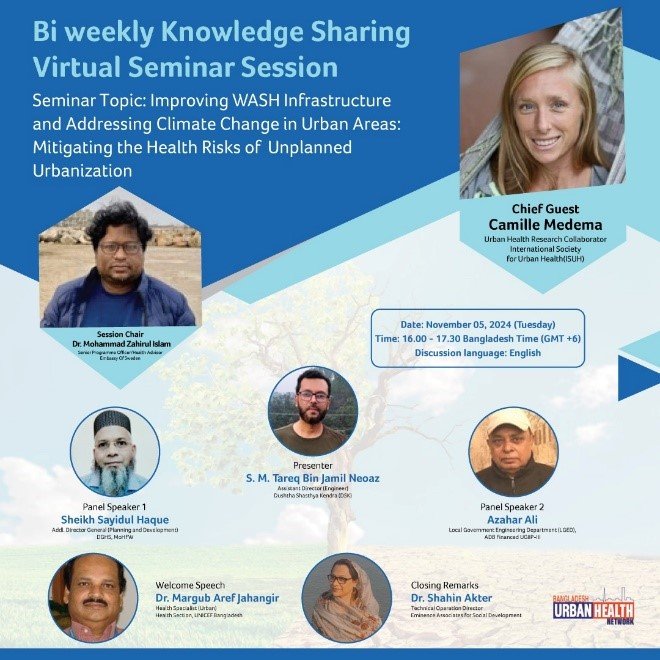
The 2nd bi-weekly Knowledge Sharing Virtual Seminar Session, titled “Improving WASH Infrastructure and Addressing Climate Change in Urban Areas: Mitigating the Health Risks of Unplanned Urbanization,” was successfully held on November 5, 2024, from 4:00 PM to 5:30 PM (BST) via the Zoom platform. Organized by the Bangladesh Urban Health Network (BUHN), this insightful session was moderated by Dr. Maliha Khan Majlish, Senior Technical and Development Officer at Eminence Associates for Social Development. The seminar brought together experts, researchers, and practitioners to discuss the intertwined challenges of urbanization, climate change, and WASH (water, sanitation, and hygiene) infrastructure in Bangladesh's rapidly growing urban areas. The session explored innovative solutions, governance improvements, and practical approaches to address these issues while mitigating health risks.
The seminar commenced with an inspiring welcome speech by Dr. Margub Aref Jahangir, Health Officer (Urban) at UNICEF Bangladesh, emphasized the urgency of cross-sectoral collaboration and partnerships to address public health challenges in urban areas caused by rapid urbanization, inadequate WASH infrastructure, and climate-related vulnerabilities.
The keynote presentation, delivered by S. M. Tareq Bin Jamil Neoaz, Assistant Director (Engineer) at DSK, highlighted the challenges of rapid urbanization and climate change on urban WASH systems, particularly in underserved areas, while presenting DSK's innovative, community-based solutions and emphasizing tailored strategies to enhance resilience and meet diverse urban needs.
The panel discussion featured esteemed experts who offered diverse perspectives on the issues at hand. Azahar Ali, from the Governance Improvement and Capacity Development (GICD) initiative under the Improving Urban Governance and Infrastructure Project (IUGIP), emphasized challenges in resource mobilization and gender-responsive budgeting for local governments while advocating conditional support models to improve governance and WASH services, and Mujibul Haque Munir, Head of Social Development at RDRS Bangladesh, who supported these points by stressing the need for a climate-resilient WASH theory to tackle systemic vulnerabilities from climate change.
During the Q&A and discussion session, Writer and researcher Gawher Nayeem Wahra highlighted the negative effects of submersible household pumps, advocating for rainwater harvesting and surface water management to reduce urban dependency on river water while addressing resource misuse through better planning and awareness. Dr. Md. Saidur Rahman, Team Leader at Partners in Health and Development (PHD), discussed the feasibility of surface water, deep groundwater, and rainwater harvesting in urban settings, emphasizing the importance of geological factors in selecting suitable water sources, with S. M. Tareq Bin Jamil Neoaz, Assistant Director (Engineer) at DSK pointing out groundwater contamination as a significant challenge. Gawher Nayeem Wahra also raised concerns about the impact of cheap roofing materials on water quality in coastal regions, urging the adoption of better construction practices to mitigate risks. Adding an international perspective Camille Medema, Urban Health Research Collaborator at the International Society for Urban Health (ISUH), brought an international perspective, emphasizing the need for resilient infrastructure, emergency planning, and public awareness, while showcasing ISUH’s Mud to Mortar program, which integrates healthy housing interventions and community advocacy to address climate change’s impact on urban health.
The session’s climactic moment arrived with the Chief Guest Camille Medema, Urban Health Research Collaborator at the International Society for Urban Health (ISUH), emphasizing inclusive planning and climate-resilient WASH infrastructure with community involvement, while the Session Chair Dr. Mohammad Zahirul Islam, Senior Programme Officer and Health Advisor at the Embassy of Sweden highlighted the interconnectedness of climate change, WASH infrastructure, and urban health, advocating for collaborative approaches to address these complex challenges effectively.
In the closing remarks, Dr. Shahin Akter, Technical Operation Director at Eminence Associates for Social Development, emphasized gratitude to participants while underscoring the need for effective groundwater management, resilient infrastructure, climate-focused urban planning, and sustained efforts to develop climate-resilient WASH systems and promote good governance.
The seminar concluded with key recommendations, including strengthening governance and funding for sustainable WASH services, developing resilient infrastructure master plans, integrating climate resilience into WASH designs, enforcing safety regulations, and engaging communities to address health risks in vulnerable urban areas. Overall, this seminar provided a vital platform for collaboration and knowledge exchange among urban health stakeholders, emphasizing the need for integrated strategies and cross-sectoral partnerships to address the interconnected challenges of climate change, urbanization, and public health, fostering a collective commitment to sustainable urban health solutions for a resilient future.